
There is a moment every growing eCommerce brand eventually hits — the moment when the platform that once felt powerful enough starts feeling like a cage. You want to launch a mobile app that looks and performs nothing like your website. You want your checkout to be lightning fast. You want to push personalized content to ten different channels without rebuilding everything from scratch. But your monolithic platform won't let you. Not without a fight, and not without slowing everything down. That frustration, felt by thousands of fast-scaling brands, is exactly why the conversation around headless commerce development services has shifted from "interesting option" to "strategic necessity" in 2026.
The numbers alone tell a compelling story. The global headless commerce market, valued at $1.74 billion in 2025, is projected to reach $7.16 billion by 2032 — a 22.4% compound annual growth rate that significantly outpaces broader eCommerce growth. And 73% of businesses have already transitioned to headless architecture, a 14% increase from just a few years ago. This isn't a trend driven by hype. It's a shift driven by results faster stores, better conversion rates, and the ability to grow without being held back by your own technology stack.
What Is Headless Commerce and Why Does It Matter?
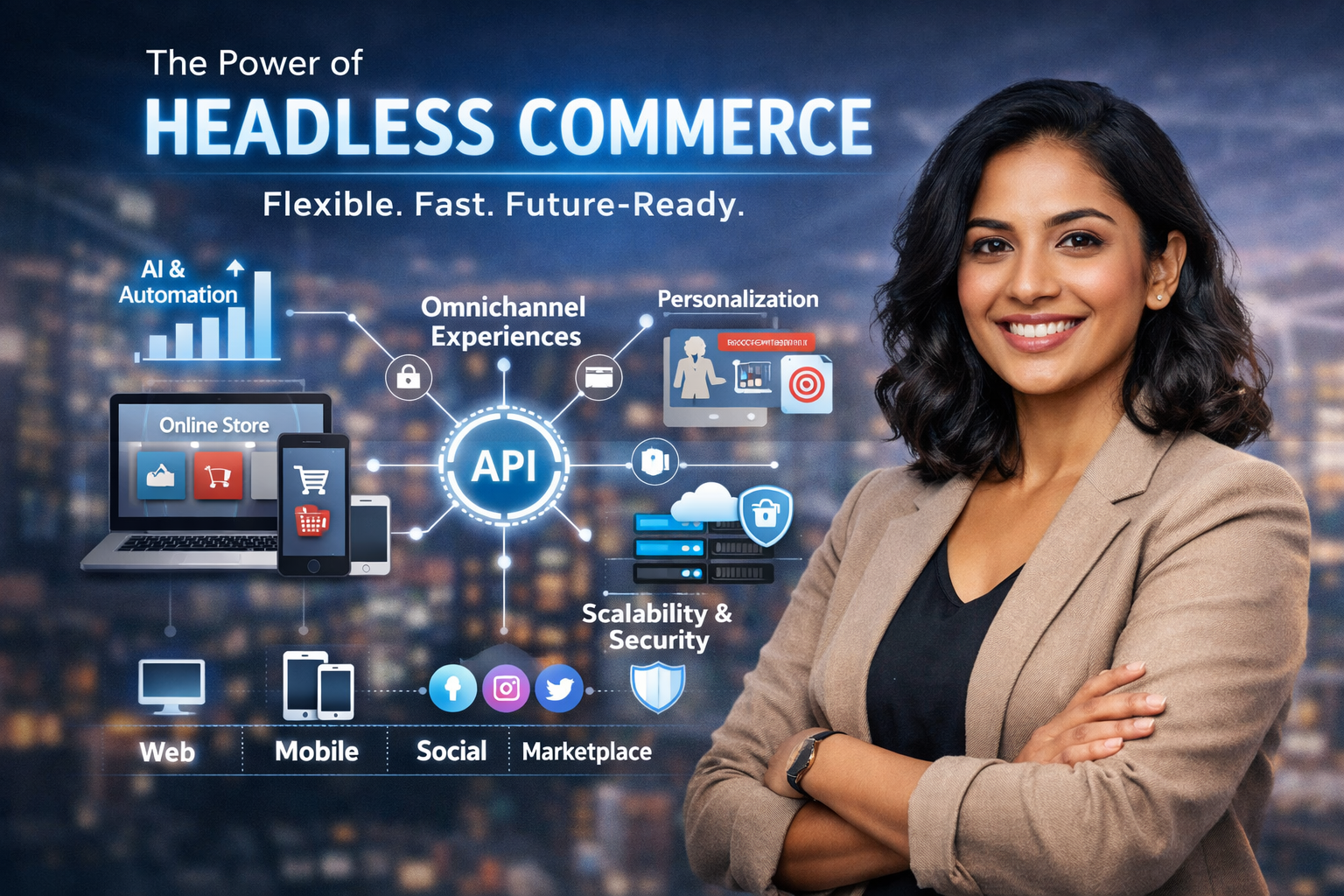
At its core, Headless Commerce Development refers to an architectural approach where the frontend of your store what customers see and interact with is completely separated from the backend commerce engine that manages products, orders, inventory, and payments. Instead of being locked into one rigid system, the two layers communicate through APIs, giving your development team the freedom to build any customer-facing experience they want, using any modern framework they choose, while the commerce backbone keeps running smoothly in the background.
The contrast with traditional monolithic platforms is stark. In a coupled system, every change to the storefront risks touching the backend. New features take longer to ship. Customization hits a ceiling. And as you add more plugins and integrations to compensate, performance degrades. Headless Commerce Development breaks that dependency entirely and for fast-growing brands, that break is everything.
The Real Reasons Fast-Growing Brands Are Making the Move
1. Speed That Actually Converts
Page speed is no longer just a technical concern it's a revenue concern. Research consistently shows that every one-second improvement in page load time increases conversions by 2%. On the flip side, a one-second delay can reduce conversions by up to 20%. Traditional monolithic platforms are inherently slower because the frontend and backend are processing simultaneously. Headless architecture eliminates that bottleneck entirely. Storefronts built with modern JavaScript frameworks like Next.js or Nuxt.js common choices in headless commerce development services projects routinely achieve Lighthouse performance scores above 90, delivering sub-second load times that old-school themes simply cannot match. Nike, for one, reported up to a 30% increase in page load speeds after going headless.
2. True Omnichannel Flexibility
Modern consumers don't shop in one place. They discover products on Instagram, research on their phone, and complete the purchase on a desktop or vice versa, or through a voice assistant, or an in-store kiosk. Brands with strong omnichannel strategies retain 89% of customers, compared to just 33% for brands with weak omnichannel approaches. Headless architecture makes genuine omnichannel possible without duplication. One backend feeds consistent product data, inventory, and pricing to every channel web, mobile app, social commerce, digital signage, or whatever comes next. Your team builds once and deploys everywhere, without rebuilding the commerce engine each time.
3. Personalization at Scale
AI-driven personalization is becoming a serious revenue lever. Companies implementing intelligent personalization report a 369% increase in average order value during personalized sessions, and businesses with strong personalization strategies generate 40% more revenue than those without. But meaningful personalization requires data flexibility the ability to serve different experiences to different users in real time. That is something monolithic platforms were never designed to handle. In headless commerce development services , the decoupled frontend can be connected directly to AI personalization engines, recommendation platforms, and behavioral data tools without rearchitecting the entire system every time a new integration is needed.
4. Faster Time to Market
One of the most practical advantages that development teams cite again and again is speed of iteration. In a traditional coupled system, frontend changes often require backend coordination. A new landing page layout, a different checkout flow, a redesigned product page these take longer because multiple teams are involved and the risk of breaking something is real. With a headless setup, frontend developers can work completely independently. Teams report up to 50% faster deployment of new features and a 40% reduction in development cycles. For brands competing in fast-moving markets where speed to launch genuinely matters, this operational efficiency compounds quickly into competitive advantage.
5. Scalability Without Re-platforming
Brands that have built on monolithic platforms often find themselves re-platforming every few years as they outgrow the system's limits. Headless architecture eliminates much of that cycle. Because the frontend and backend can be scaled independently, you can handle massive traffic spikes — Black Friday, viral marketing moments, flash sales — by scaling only the layer that needs it, without impacting everything else. Most headless commerce implementations achieve positive ROI within 12 to 18 months, and over a three-year period, the total cost of ownership advantage can reach $500,000 to $1 million for enterprise-scale brands when you factor in the savings from avoided re-platforming, reduced maintenance complexity, and conversion improvements.
Who Should Seriously Consider Headless Commerce Development Services?
Not every business needs to go headless today, and anyone honest about this space will tell you that. Smaller brands with straightforward product catalogs and limited technical resources may find the upfront investment and learning curve outweigh the benefits in the short term. A well-managed Shopify or BigCommerce store can absolutely perform well for the right use case.
But if your business is experiencing any of the following, the conversation around headless commerce development services deserves serious attention:
Your current platform is slowing down your marketing team's ability to launch campaigns quickly
You're trying to sell across multiple channels but finding it difficult to maintain a consistent experience
Your store's performance scores are dragging down your conversion rates and SEO rankings
You're planning significant international expansion and need localized storefronts without building entirely separate systems
Your development team is spending more time working around platform limitations than building new features
These are the signals that your architecture is becoming the ceiling, not the floor.
Choosing the Right Partner for Headless Commerce Development
The technology itself is only part of the equation. Headless Commerce Development projects succeed or fail based on the quality of execution and that means choosing a development partner with genuine hands-on experience, not just familiarity with the buzzwords.
Look for teams that can demonstrate real production-grade headless builds across platforms like Shopify Headless (Hydrogen), BigCommerce, Commercetools, or Medusa.js. Ask how they approach API design, how they handle performance optimization at the frontend level, and what their strategy is for integrating headless CMS platforms like Contentful, Sanity, or Hygraph alongside the commerce backend.
The best providers of headless commerce development services don't just build what you ask for. They help you think through the architecture decisions that will shape your platform's growth for the next three to five years. They ask hard questions about your team's capacity to manage a more complex system. They start with a phased approach where possible, delivering ROI incrementally rather than betting everything on a single big-bang migration.
The Bottom Line
The brands dominating digital commerce in 2026 are not necessarily the biggest they are the most adaptable. Headless architecture gives eCommerce businesses the technical foundation to move fast, personalize deeply, sell everywhere, and scale without limits. That is why investment in headless commerce development services continues to accelerate, and why brands that delay this conversation risk finding themselves constrained by their own infrastructure precisely when growth demands the most from them.
If your current platform is starting to feel like a bottleneck rather than a launchpad, now is the right time to explore what headless can unlock for your business.
Share



Write a comment ...